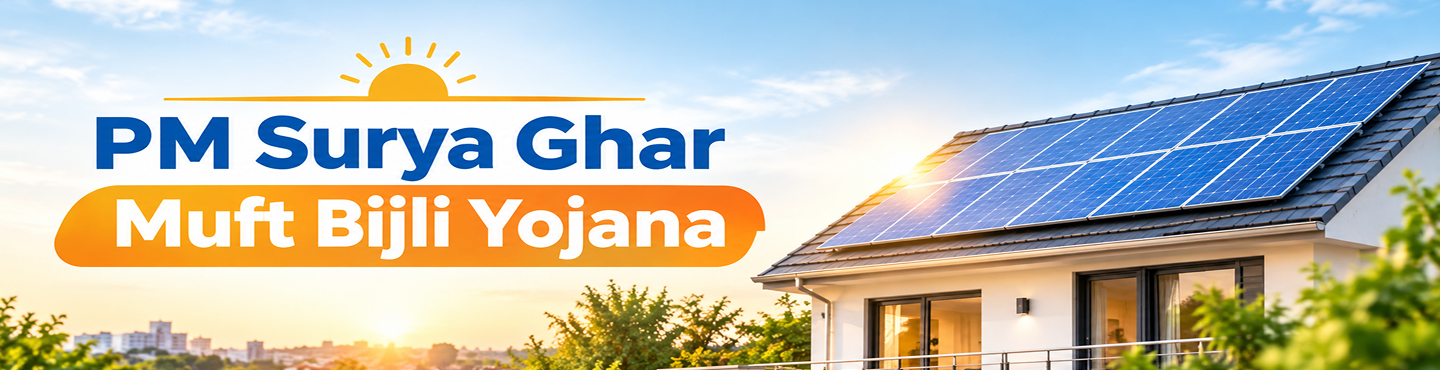
PM Surya Ghar Muft Bijli Yojana
Introduction
Launched in February 2024, PM Surya Ghar: Muft Bijli Yojana is the Government of India's flagship residential rooftop solar scheme — and by most measures, the largest domestic rooftop solar program in the world by targeted beneficiary count. The goal: one crore (1,00,00,000) households running on rooftop solar, each getting up to 300 units of free electricity every month.
For an average household paying ₹3,000–6,000 in monthly electricity bills, the scheme can bring that bill close to zero — with the government footing a substantial part of the installation cost through direct subsidy. This guide covers the exact subsidy amounts by system size, who qualifies (and who doesn't), where to apply, the mistakes that get applications rejected, and how UrjaOne connects consumers with verified vendors — and vendors with real customers — for this scheme.
What Is PM Surya Ghar Muft Bijli Yojana?
PM Surya Ghar is a Central Financial Assistance (CFA) scheme run by the Ministry of New and Renewable Energy (MNRE), implemented through state DISCOMs and a single national portal. It replaced the earlier Grid Connected Rooftop Solar Programme Phase II and pays homeowners a direct subsidy — credited straight to their bank account — for installing a grid-connected rooftop solar system on their home.
Once commissioned, the system:
- Reduces or eliminates the household's dependence on grid electricity during the day
- Exports surplus power to the grid through net metering, offsetting future bills
- Can provide up to 300 units of free electricity per month for an appropriately sized system matched to household consumption
PM Surya Ghar Subsidy: kW-Wise Breakdown
The Central Financial Assistance is tiered by system capacity, not a flat percentage of cost:
System Size | Central Subsidy (CFA) |
|---|---|
1 kW | ₹30,000 |
2 kW | ₹60,000 (₹30,000/kW for the first 2 kW) |
3 kW | ₹78,000 (₹60,000 for first 2 kW + ₹18,000 for the 3rd kW) |
Above 3 kW | Capped at ₹78,000 — no additional subsidy beyond 3 kW, even for larger systems |
How the calculation works: The subsidy runs at ₹30,000 per kW for the first 2 kW, then drops to ₹18,000 for the third kW, and is capped at ₹78,000 regardless of how much larger the system actually is. So a 5 kW or 10 kW residential system receives the same ₹78,000 subsidy as a 3 kW system — the additional capacity is paid for entirely by the homeowner (though it still generates more power and larger bill savings over time).
Disbursal: The subsidy is transferred via Direct Benefit Transfer (DBT) directly to the homeowner's Aadhaar-seeded bank account, typically 30–45 days after DISCOM inspection and commissioning — though the full cycle from application to subsidy receipt commonly takes 45–90 days depending on state processing speed.
Installations Completed So Far
Progress under the scheme has been accelerating through 2026:
- As of May 2026, roughly 60.95 lakh applications had been received nationally, with 31.38 lakh rooftop installations completed.
- By mid-2026, cumulative installations crossed 40 lakh households.
- As of July 2026, approximately 47.26 lakh households had been solarised under the scheme.
- The government's interim target is 75 lakh installations by December 2026, en route to the ultimate goal of 1 crore households.
- The Union Budget 2026–27 allocated ₹22,000 crore to the scheme, up from a revised estimate of ₹17,000 crore in FY26 — signalling continued acceleration in funding and rollout.
Note: Installation figures are updated periodically by MNRE and vary slightly across reporting sources depending on the cutoff date — always check the official national portal or recent Press Information Bureau (PIB) releases for the latest confirmed numbers.
Who Is Eligible?
To qualify for PM Surya Ghar, an applicant generally must:
- Be an Indian citizen who owns the residential property where the system will be installed
- Have a valid electricity connection in their own name, with a residential (domestic) tariff category
- Have a sanctioned load of 10 kW or below in most cases (system size cannot exceed the sanctioned DISCOM load — oversized proposals require a separate load-enhancement application first)
- Have available, shade-free rooftop space suitable for solar panel installation
- Have a bank account seeded with Aadhaar, since the subsidy is disbursed via DBT
- Install the system through an MNRE-empanelled vendor, using ALMM (Approved List of Models and Manufacturers)-listed solar modules
Who Is NOT Eligible?
- Commercial and industrial consumers — the scheme covers residential rooftop solar only; commercial-category connections are not eligible for this particular subsidy (separate schemes and open access routes exist for C&I consumers)
- Renters or non-owners of the property, in most cases, since the connection and subsidy must typically align with the property owner's name
- Consumers without a domestic-category electricity connection in their own name
- Applicants proposing system sizes that exceed their sanctioned load, without first applying for load enhancement
- Installations using non-ALMM-listed panels — these fail DISCOM inspection and forfeit the subsidy entirely, regardless of otherwise-correct paperwork
- Existing solar installations not installed via an empanelled vendor — retrofitting an existing system into the scheme is only possible in limited cases, and generally requires it to have used ALMM-listed panels through an approved vendor
Main Portals to Register
- National Portal for Rooftop Solar — pmsuryaghar.gov.in — the primary application portal for consumers nationwide, coordinated by MNRE. This is where most homeowners register, select their DISCOM, choose an empanelled vendor, and track application status.
- State DISCOM portals — many state electricity boards also route technical feasibility approval and net-metering applications through their own portals, working in coordination with the national system.
- State renewable energy nodal agency websites — in some states, additional state-level top-up subsidies (on top of the central CFA) are processed through the state nodal agency rather than the national portal alone.
Important: Only the official national portal and recognized state DISCOM/nodal agency portals should be used. MNRE has flagged fraudulent websites and agents charging advance "registration fees" — the actual government application process does not require any such payment.
Step-by-Step Application Process
- Register on pmsuryaghar.gov.in with your state, DISCOM, and electricity consumer/account number.
- Submit application details — property and connection information, along with your desired system capacity.
- Get technical feasibility approval from your DISCOM.
- Choose an empanelled vendor from the registered list on the portal (or already have one in mind, provided they are MNRE-empanelled).
- Installation — the vendor installs the system using ALMM-listed modules, sized appropriately to your sanctioned load and consumption pattern.
- Net meter application — apply for and get a net meter installed by the DISCOM after commissioning.
- DISCOM inspection and commissioning certificate — the DISCOM verifies the installation meets scheme requirements.
- Submit bank details — provide your Aadhaar-seeded bank account for subsidy disbursal.
- Receive subsidy via DBT — typically within 30–45 days of successful commissioning, subject to your state's processing timelines.
Common Mistakes That Delay or Reject Applications
- Non-ALMM-listed panels — by far the most common and costly mistake. If the installed panels aren't on the current ALMM List (List-II requirements for cells apply to systems commissioned after mid-2026), the installation fails inspection and the subsidy is forfeited entirely.
- Un-seeded Aadhaar-bank account — if your bank account isn't Aadhaar-linked, the DBT transfer fails even after approval, and correcting this can significantly delay disbursal.
- System size exceeding sanctioned load — proposing a system larger than your DISCOM-sanctioned connection load without first applying for load enhancement is a frequent rejection reason.
- Name mismatches — inconsistencies between the name on the electricity connection, Aadhaar, and bank account can stall verification.
- Using a non-empanelled vendor — installations must go through an MNRE-empanelled vendor; using an unregistered installer, even a technically competent one, disqualifies the subsidy claim.
- Vendor pricing games — some installers quote a low headline price but cut corners on panel quality or inflate "additional" charges after subsidy approval; always get a written, itemized quote referencing ALMM-listed components before committing.
- Delayed net-metering application — some homeowners install the system but delay applying for the net meter, which stalls the entire commissioning and subsidy timeline unnecessarily.
By some industry estimates, roughly one in three applications faces some form of rejection or delay — almost always traceable to one of the mistakes above, most of which are entirely avoidable with the right vendor and paperwork discipline.
How UrjaOne Helps Consumers Find the Right Vendor
Choosing the right installer is the single biggest factor in whether a PM Surya Ghar application goes smoothly or gets stuck for months. Through UrjaOne, homeowners can:
- Browse verified, MNRE-aligned solar partners in their city and district, rather than relying on unverified local contacts
- Compare company profiles, certifications, and customer reviews before choosing an installer
- Get connected with installers who are experienced specifically with PM Surya Ghar paperwork — reducing the risk of ALMM, load-sanction, or documentation errors
- Avoid the common trap of unverified installers who quote low but use non-compliant equipment
How UrjaOne Helps Vendors Find Customers
For solar EPCs, installers, and consultants, PM Surya Ghar's rapid growth is also a major lead-generation opportunity — but only if the right customers can find you. UrjaOne helps vendors by:
- Delivering verified, geo-matched leads of homeowners actively applying under PM Surya Ghar in your service area
- Providing a free company profile and marketplace listing, so customers researching PM Surya Ghar vendors can discover and evaluate your business
- Offering a built-in CRM to manage leads, quotes, and installation timelines from one dashboard — useful for tracking PM Surya Ghar-specific milestones like DISCOM inspection and subsidy disbursal status
- Issuing a Channel Partner Letter that adds credibility when approaching housing societies and RWAs about group rooftop solar adoption
- Reducing dependence on cold marketing spend by connecting you with customers who are already in-market and motivated by the subsidy itself
If you're a solar installer looking to grow through PM Surya Ghar demand, you can register as a UrjaOne partner for free and start receiving verified leads in your city.
Frequently Asked Questions
How much subsidy can I get under PM Surya Ghar? Up to ₹78,000 — ₹30,000 for a 1 kW system, ₹60,000 for 2 kW, and ₹78,000 for 3 kW or larger systems (the subsidy is capped at ₹78,000 even for bigger installations).
How many households have installed rooftop solar under this scheme so far? As of mid-2026, cumulative installations were in the range of 40–47 lakh households nationally, against a government target of 75 lakh by December 2026 and an ultimate goal of 1 crore households.
Are commercial properties eligible? No — PM Surya Ghar's central subsidy is designed specifically for residential rooftop solar. Commercial and industrial consumers are not eligible under this scheme.
What is the biggest reason applications get rejected? Using solar panels that aren't on the MNRE's ALMM (Approved List of Models and Manufacturers) list — this alone accounts for a large share of rejected or stalled claims.
How long does it take to receive the subsidy after installation? Typically 30–45 days after DISCOM inspection and commissioning, though the full process from application to subsidy receipt commonly takes 45–90 days depending on your state's processing speed.
Can I install a system larger than 3 kW? Yes, up to your sanctioned load (commonly up to 10 kW for residential connections), but the subsidy remains capped at ₹78,000 regardless of the additional capacity you install.
Related Blogs

Madhya Pradesh Power Discoms - Complete Guide

Delhi Power Discoms - Complete Guide

UP Power Discoms Complete Guide

Assam Power Discom (APDCL) - Complete Guide
Open Access Electricity
Hybrid Solar System